
We’re always super excited to discover a new country, a new city, a new place. Until the moment we have to figure out how to use their transportation system. It’s intimidating, not always clear, and there’s always this feeling that there are obvious rules for locals that are never mentioned anywhere. Lucky for you if you’re an English-speaking visitor: I’m French, I know French trains inside and out, and I’ll explain everything in this complete guide on how to take the train in France in English!
Before I go any further, don’t forget to find me on Instagram, Pinterest and Youtube.
The different types of trains in France
In mainland France, trains are operated by the SNCF, except in Corsica. You can book all your tickets on their website or app (more on that below). I highly recommend downloading their app so you have all your tickets at your fingertips.
Under the SNCF umbrella, you’ll find several types of trains:
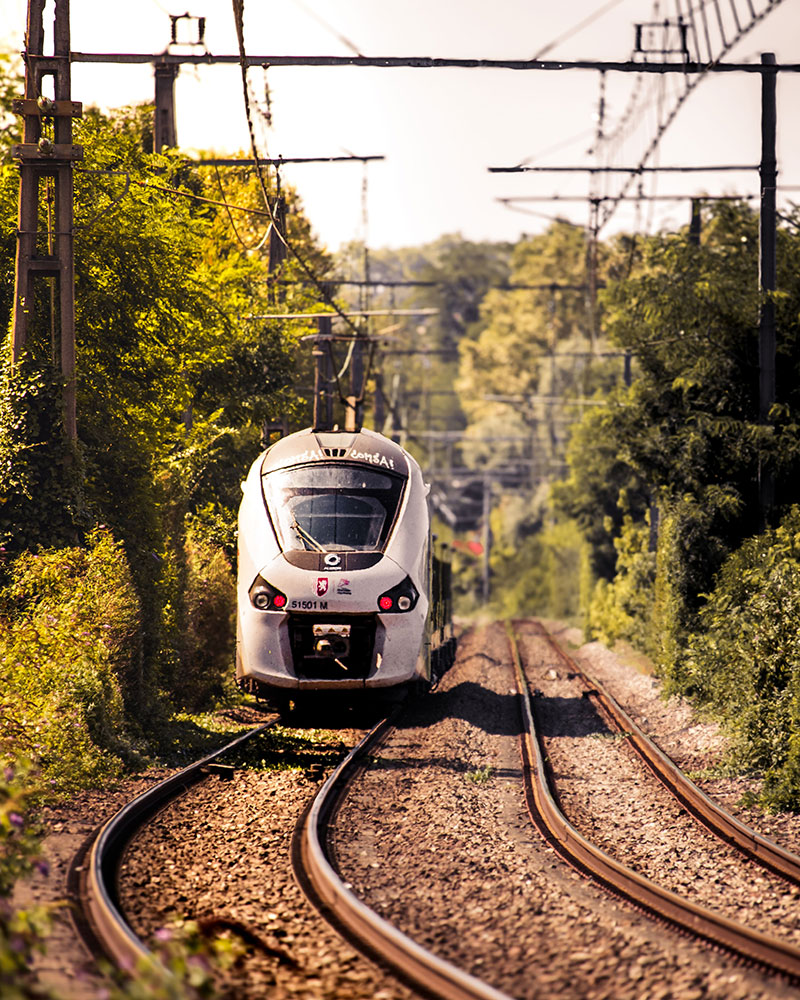
- Les TGV (high-speed trains): the fastest trains, usually covering long distances. These trains generally make fewer stops and mostly have wifi. Seats are assigned.
- Ouigo: also high-speed trains, but the low-cost version. Make sure to reserve space for large luggage in advance, otherwise it costs a lot more on the day of travel. Trust my experience on this one. These trains usually have wifi, but it may be a paid option depending on your ticket. Seats are assigned.
- Les TER (regional express trains): slower trains that don’t go as far but make more stops to serve smaller stations in their region. Good to know: these trains are managed at the regional level and often change names depending on where you are! For example, on the French Riviera (around Marseille, Cannes, and Nice), the network is called ZOU!. In Normandy, it’s called Nomad, and in Occitanie, liO. These trains usually don’t have wifi available. Seating is unassigned.
- Intercités: mainly for medium and long distances, but unlike TGVs, Intercités trains run on standard tracks. These trains usually don’t have wifi available. Seats can be assigned or unassigned.
- RER et Transilien: a network that only serves the Paris region and its greater suburbs. These trains usually don’t have wifi available. Seating is unassigned.
How do book your train tickets in France?
Pour réserver vos billets de train en France c’est assez simple. Tout est centralisé sur la Booking train tickets in France is pretty simple. Everything is centralized on the SNCF Connect platform. You can create a free account, which I recommend so you can easily find your tickets again, and also to have access to all your tickets in the app, which will become your best friend during your travels.

Once on the homepage, you can type in your destination and add your departure station. I’ll admit I don’t find that very logical, you’d think you’d enter the departure station first, but I’m just the messenger here, not the one who designed the website.

You can then choose your times and whether you want a return ticket. Next, add who’s traveling with you. I can easily add my boyfriend by clicking on “traveler” since we each created our own profile under my account. A simple step that saves you a bit of time if you always travel with the same people. You’ll then have access to pricing.

You’ll notice that prices vary quite a bit from one train to another. There are several reasons for this: demand for a specific time slot compared to another, but also the length of the trip (whether you’re taking a TGV or a TER), and whether you’re taking a direct train or one with connections. If you’re flexible with your travel times, it’s worth playing around with the options to see what’s available and save a few euros.
Another important difference to note for most trains (except RER and Transilien): you have a choice between 2 types of seating, second class and first class. The difference isn’t as dramatic as on planes, don’t expect champagne service, even though we are in France.
Second class: this is the standard option, with 2 seats on each side and an aisle in the middle. You’ll also find groups of 4 seats, 2 facing each other with a table in between. There are often outlets in the middle to share with your neighbour.
First class: instead of 4 seats, you get 3 seats per row, so a bit more space and reclining seats. One outlet per seat, the option of an isolated seat, or even 2 seats facing each other with a table in between. This is generally what we book when traveling as a couple, for a bit more comfort and space after a long flight. You can also reserve your specific seat instead of having one automatically assigned. This is also handy when traveling with a lot of luggage, since you can choose seats near the luggage storage area to keep an eye on it easily.
My tip: always compare prices, sometimes there’s only a few euros of difference. On a long trip, it’s nice to have a bit more space and often quieter cars. First class isn’t reserved for millionaires at all, prices vary based on supply and demand, so sometimes it’s really worth spending a few extra euros.
Once you’ve chosen the ticket that works for you, you can move on to payment. You’ll have the option to add insurance. I often get it for the train we take from Charles de Gaulle airport to reach my hometown in the Ardèche. Simply because I don’t want to repay 100% for train tickets if our flight is delayed.

Congratulations, you have your ticket in hand. Now what? Check that your tickets are properly available in your app. If your phone has the option, I encourage you to add them to your wallet or cards app depending on your phone. That way, your tickets will always be accessible, even without network coverage. You’ll also get a reminder on your phone an hour before, depending on your settings.
How to catch your train in France?
Careful: the time listed for your train is the time the train leaves the platform, not when you need to arrive. Doors close a few minutes before that. You’ll no longer have access to the platform a few minutes before departure. Give yourself enough time to get there, especially if you’re not familiar with the SNCF system and train stations.
How to find you train on the platform?
When looking for your train, you’ll need to search for the terminus city, not necessarily your own stop. A concrete example: I’m leaving from Paris Charles de Gaulle for Valence TGV. But the train actually continues on to Marseille St Charles. So on the screen, I look for the train going to Marseille St Charles. Not all the stations served are listed on the main screen.
In smaller stations, it’s pretty simple, there are often only one or two platforms. You can find the info on the departures screen. There’s also an arrivals screen, so make sure to check carefully. They’re not the same color: the screen with a blue background is for departures, the one with a yellow background is for arrivals.
For slightly bigger stations, same idea, look for the screens to find your train, but there will potentially be more platforms, so it’ll take you a bit more time to find your way. If your platform is D, follow the signs to platform D.
Once you’re on the platform, you’ll find these long, narrow screens showing a train diagram. You’ll see each car represented with a letter next to it. Spot that same letter on the platform to know roughly where your car will stop. A small trick that’ll save you from dragging your suitcases from one end of the platform to the other. Never a fun experience, especially at the start of your vacation.
How to validate your train ticket in France?
There was a time when tickets were paper and you had to stamp them in a machine to get the validation date. Those days are over, welcome to the digital era. In some stations, you’ll need to scan your ticket at a turnstile to open the gate giving you access to the platforms. Or in some stations, like Paris Charles de Gaulle for example, staff will scan each ticket. In smaller stations, neither of these happens, and the check will be done by conductors on the train.
If you don’t have a ticket, I recommend going up to them to explain the situation. This has happened to me several times when I was a student. I’d have to jump on the TER to get to school on time, and I’d buy my ticket directly from the controller on the train. Generally, if you approach them proactively instead of waiting to be checked, you can avoid the surcharge. Without a ticket, you can be fined.
How to find your seat on the train?
When you enter your car, you’ll see the seat numbers above the doors. For example: 55 to 95 on one side, and 96 to 135 on the other. Sometimes you’ll sit down in a seat, convinced it’s yours. Yes, I’m car 2, seat 132. Someone shows up saying they’re also seat 132. Before panicking or getting annoyed, depending on your personality, both check the car number. It’s very common to read “car 2” and board, except car 2 was actually to the right and you went left. So now you’re in car 1 or 3. Not 2. No worries, you can easily move from one car to another and find your seat.
What to do in case of a train delay in France?
The first thing to do: be patient. The truth is, if you take the train several times during your stay in France, you’ll probably experience a delay at some point. Might as well prepare for it together, because you do have rights!
There are 2 types of delays:
- delay at the station while you’re still waiting for your train.
- a delay where you’re stuck on the train.
If you’ve provided your email, your phone number, and you have the app: you’ll be kept informed of the delay. It’ll also be displayed on the screens at the station.
The rules then depend on the type of train you booked.
For TGV/Intercités, there’s the G30 compensation guarantee. That means starting at 30 minutes, you can request a partial refund, and it increases progressively.
- De 30 à 59 minutes de retard: 25% du prix de votre billet en bon d’achat
- De 1 à 2h de retard: 25% du prix de votre billet en bon d’achat ou virement
- De 2 à 3h de retard: 50% du prix de votre billet en bon d’achat ou virement
- Plus de 3h de retard: 75% du prix de votre billet en bon d’achat ou virement
You can find all the information to file your claim here.
For Ouigo, the refund is automatically triggered after 1 hour of delay.
- Less than 1 hour late: no refund
- 1 to 2 hours late: 25% of your ticket price as a voucher
- More than 2 hours late: 50% of your ticket price as a voucher
For TER trains, refund rules vary by region and are generally less generous than for TGV/Intercités. I’d encourage you to check the specific rules for the region you’re traveling through.

Now that you have all the information you need on how to take the train in France, all that’s left is to pick your next destination and hop aboard. If you’re looking for ideas, check out my guides to discovering Cannes and its surroundings, or the must-do activities in the Ardèche. And if you need an eSIM to use your phone during your trip, I’ve got you covered there too.
Bon voyage.