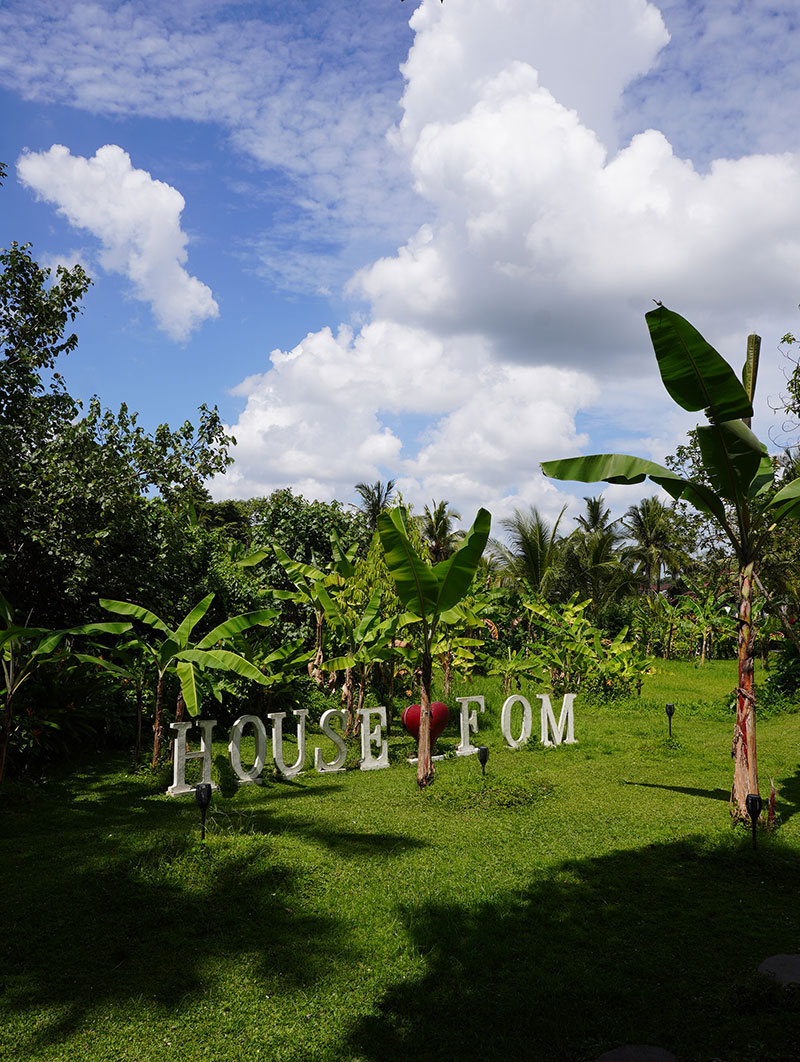

It’s been exactly one year since I booked my spot for the House of Om Bali yoga teacher training in November 2025. I made that decision right after my lipedema diagnosis, at a pretty vulnerable point in my life, I was searching for the best yoga school in Bali to help me through that transition. I did a ton of research, but honestly, it was hard to find real, detailed reviews. So here’s my contribution, in the hopes it helps you make the best choice for you. I’m sharing my full House of Om Bali review, based on my own experience with their 200-hour yoga teacher training.
Read to the end for a 5% discount on your registration with my code.
Before I go any further, don’t forget to find me on Instagram, Pinterest and Youtube.
My Bali vlogs:
- Leaving Toronto for Bali
- First week of yoga training in Bali
- Second week of yoga training in Bali
- End of the yoga training in Bali
- Last days in Bali

A Bit of History on House of Om
House of Om was founded by Wissam Barakeh in 2016 in Dubai. His original idea was to turn his home into a spiritual centre, a place where people could gather under one roof to share their knowledge of yoga and meditation. Over the years, things evolved, and he decided to grow House of Om by opening its first school in Bali (the Amertham campus). In 2020, following the pandemic, the online academy launched. Everything moved quickly after that: The Mansion in 2021, Melati (my school) in 2022, the first school in India opened in 2023, the third Bali campus in 2024, the first Thailand location in 2025, and there’s a new Bali campus coming soon.
The Different House of Om Campuses
As part of this House of Om Bali review, here’s a quick rundown of each campus so you can pick the environment that fits you best. I can mainly speak to Melati (Bali), where I did my training, and The Mansion, since I visited and talked to people who trained there. To help you figure out what suits you best, here’s a quick rundown of each campus.
Keep in mind the program is the same across every campus, so you can simply pick the environment that fits you best.
As for rooms, each campus has its own range, from dorms to private rooms, and you can check the options on House of Om’s website. Each room type has a different price. I’ll go into more detail on the Melati room options further down.
House of Om, Melati, Bali
This is one of the campuses House of Om owns outright, so they have more freedom here. You’re only a 15-minute walk from central Ubud, there are cafés and restaurants nearby, and there’s a pool on-site. Since there are only two shalas, there’s generally just one group on campus at a time (students only). In our case, a hybrid group arrived for the last 10 days. This is ideal if you want easy access to explore Ubud, grab a massage after class, or eat out (I actually have a list of my favourite Ubud restaurants here). I’d also recommend it if you want to be close to town while staying in a more intimate setting.
If you want to arrive a few days early to acclimate (which I highly recommend), make sure to read my full review of the Outpost Ubud hotel and co-working space, located right across the street from the campus.
House of Om, The Mansion, Bali
As the name suggests, The Mansion is exactly that: a fairly large resort-style complex. Six pools, huge grounds, beautiful gardens. The space is noticeably bigger than Melati and can feel a bit more intimidating. I also find it’s less convenient for walking into town, though a taxi (scooter or car) is easy to grab. It’s often described online as “the Instagrammers’ campus,” which gives you a sense of the vibe. That said, the teaching is identical, The Mansion and Melati are only 10 minutes apart, and teachers move between both campuses.
One thing to note: since you’re staying in a hotel here, you’re not surrounded only by fellow students, there are tourists too but people I talked to told me it didn’t really bother them.
House of Om, Amertham, Bali
This was the first campus after House of Om launched in Dubai. It’s further from Ubud, tucked into the jungle, roughly 30 minutes by car, but also about 20 minutes from the ocean. I never visited in person, but based on the call I had with the team while choosing my campus, Amertham is ideal if you’re after total disconnection, since getting to Ubud takes a bit more time and effort. If you’re craving a deep connection with nature, this might be the one for you.
House of Om, Pelaga, Bali
This campus wasn’t available yet when I booked in 2025, and there’s not much information online beyond their own site. They describe it as more mountain-set, with beautiful views.
Rishikesh, India
Leaving Bali behind for this one: Rishikesh, known as the world capital of yoga. I won’t lie, the photos alone make me want to sign up for a second training. The school sits in the Himalayan mountains, completely removed from outside distractions, leaving plenty of room to focus on your learning. Ideal if you want to feel that yoga connection at its purest.
Koh Phangan, Thailand
The newest school, set on Thailand’s beautiful beaches. The campus looks like it’s straight off a postcard. You’re truly right on the ocean, on a tropical island. It’s a very different experience from Ubud, that’s for sure, but also likely a stunning one, being that close to the water and nature.

The Types of Training House of Om Offers
Now that you know more about the campus options for this House of Om Bali review, let’s talk about the different training formats available.
Note that groups can be mixed depending on demand. In my session, we had one man and 28 women. Men are required to book a private room unless they’re attending with a friend or another man also registers.
200-Hour
The 200-hour training happens in person, on the campus of your choice, over 20 days. This is the foundational certification to become a yoga teacher, and it’s open to everyone. In my group, some students had practiced yoga for over 10 years, others for a few years, and some for just six months.
200-Hour Hybrid
Half of this training happens on your own time from the comfort of your home, at your own pace, and half in person on campus. Ideally, you’ll finish the theory portion at home before starting the practical part on-site, which lasts 10 days. It’s a good option if you can’t take much time off for the full in-person format. Word of caution, though: everyone I spoke with who did the hybrid version said their in-person days were even more intense than ours.
Note that all trainings are taught in English, though Melati also offers a 200-hour hybrid training in Mandarin.
300-Hour
The 300-hour training generally follows the initial 200-hour certification. It helps you refine your teaching and goes deeper into culture, philosophy, and anatomy.
300-Hour Hybrid
Same idea as the 200-hour hybrid: part online at your own pace, part in person.
Online
This option is fully online, for both the 200-hour and 300-hour trainings. Honestly, it’s the one I’d recommend least. Ideally, come do the 200 hours in person for the full immersive experience (more on that in my upcoming article on how to choose your yoga school).
Meditation
The last training House of Om offers is a meditation certification. From visualization to yoga nidra, you’ll learn several techniques to lead meditation classes or deepen your own practice. This is the one I know the least about, since I don’t have plans to take it anytime soon.

Now that you have a general picture of House of Om, its campuses, and its training options, let’s dig into my personal experience at House of Om Melati for my 200-hour yoga teacher training.
How Booking Works
Booking your spot in a House of Om yoga teacher training is fairly simple. You need to choose your campus, dates, and room type, and be ready to pay a deposit (400 USD in my case). The rest is due at most one month before the training starts. You can also reschedule your training once, for free. For example, say you paid your deposit in June for a November training, but you’re no longer available in November and would rather do it in February, you can contact them to change your dates.
The Rooms
A big part of any honest House of Om Bali review comes down to the rooms, so here’s what your options actually look like. Depending on when you register, you’ll have more or less choice on rooms. I registered in early August for a mid-November training and had my pick. I chose a private room for a few reasons:
- I knew I’d need alone time. I’m extremely social, and sometimes a private room is my only way to actually stop talking and stop scattering all my energy.
- I’ve lived alone or as a couple for over 15 years, so I’m used to having my own space.
- Financially, this training was an investment, so spending a bit more for my own space wasn’t a big deal.
- This trip also marked a transition for me between life before and after my lipedema diagnosis, and I wanted to give myself the best possible experience.
Your Room Options at House of Om Melati
Every room comes with air conditioning, a fan, and wifi. The upside of having so many options is that you can really tailor it to your budget.
Dorm Room: shared with three roommates. The most basic room, with single beds and little space for your things. I heard really positive feedback from people who shared rooms, the bond with their roommates went to another level thanks to those more intimate, shared moments.
Price: 1,700 USD
Dorm Deluxe: also shared with three roommates, but in a nicer room. Same positive feedback as above about the closeness that comes from sharing a room.
Price: 2,000 USD
Twin: shared with one other person, two single beds. The two-person version of the dorm room.
Price: 1,900 USD
Twin Deluxe: same idea, shared with one person, but a nicer room with more thoughtful décor.
Price: 2,485 USD
Semi-Private: fits three people. No one had this room during my training, and I don’t think it was even available at the time, so I can’t personally speak to it.
Price: 2,608 USD
Private: just you. This is the one I can speak to best, and the one you’ll see in my vlogs, since it’s what I booked. You get a queen bed, a small desk, a full wardrobe, and a safe (too small to fit my laptop and all my content-creator gear, but that’s a common issue in hotels too).
Price: 2,730 USD
Private Deluxe: the top-tier option at Melati. A single room with a queen bed and a small couch, it feels a bit more like a suite.
Price: 2,905 USD

Training Length
You’ll have a total of 200 hours of coursework to earn your yoga teacher certification. The training spans 20 days, but that includes three rest days and the first day, when the opening ceremony happens in the afternoon. On day 18, you’ll have your practical exams, day 19 brings the theory exam plus some activities and the closing gala in the evening (around 5pm). Day 20, your last day on-site, is the graduation ceremony from around 7:30 to 10am, after which you’ll need to have checked out of your room.
Before the Training
I recommend arriving a few days early, especially if you’re coming from a different time zone. This gives you time to adjust to the jetlag at your own pace. I booked 3 nights at the Outpost Ubud hotel, right across from House of Om Melati, and it was truly the best choice to keep logistics stress-free on day one.
And beyond the fatigue, it’s just so much nicer to arrive a few days ahead of time, get your bearings, explore the neighbourhood, and not have to worry about running late on your first day.
Arrival Day
A quick disclaimer: this is my personal experience, and yours might look a bit different. You’ll get all the specifics for your group a few weeks ahead of time through the WhatsApp group (more on that shortly). We were able to move into our rooms starting at noon on day one (for example, if your training runs November 17 to December 6, the 17th is your first day). The opening ceremony started at 2:30pm.
When you arrive, you give your name at the front desk and staff will walk you to your room. I was pleasantly surprised by the service, it genuinely felt like a hotel (I was at Melati, which isn’t one; if you’re at The Mansion, it actually is a hotel). Staff carried my suitcase to my room, gave me a quick tour, and I had plenty of time to settle in.
You can eat in the common area, which is a great way to start getting to know your classmates.
A few notes on the opening ceremony:
- You’re invited to wear white.
- You’re asked to cover your shoulders, knees, and stomach. A simple white dress works well. Keep in mind it can get very hot, so go for something flowy and light that you feel comfortable in.
- I won’t say too much, to keep a bit of the surprise, but you’ll meet your teachers, your classmates, and learn more about how the week is structured.
During the opening ceremony, you’ll find out who your lead teacher is, meet some of the teachers (not all of them can attend, depending on their other classes), and learn your group. That’s the group you’ll do team projects with and practice teaching with. Groups are simply assigned alphabetically, mine happened to be all women whose names started with A. A completely useless bit of trivia, but there you go.
You’ll also sign a contract with yourself, which you’ll get back laminated at the end. You’ll receive two laminated documents too: the sun salutations and a few mantras you’ll chant throughout the training. Then you’ll get a sarong to cover up around the pool, out of respect for staff culture, so you’re not walking around in something too revealing. You can wear a swimsuit around the pool itself, though.

The Administrative Side
Once you’re registered, the school sends you everything you need. You’ll get access to the WhatsApp group about a week before the training starts. That’s where your teachers will introduce themselves, and you’ll be invited to share a photo and short intro of yourself. You’ll also get all the info on arrival day, class schedules, and anything important before things kick off. During the training, this is where you’ll communicate with your group and teachers, and find certain resources. It’s also where you’ll occasionally hear about events happening around the school. During my training, we had a few celebrations at Alchemy Yoga next door, and one Sunday (a rest day) we were invited to The Mansion for a Bollywood dance class, totally optional.
You’ll also get access to a Google Drive with your course materials, plus a physical course book. I bought the physical version but never opened it, so I’d recommend saving your money and just following your notes and the slides in the Drive.
What Level of English Do You Need?
This is a question that comes up naturally for my French-speaking readers, but since my blog is fully bilingual (in case you didn’t know) and this article is also reaching non-native English speakers, not just native ones, it’s worth addressing here too. To be fully honest, you need a solid level of English, enough to understand things quickly and hold conversations with people.
A few reasons why:
- The classes are intense and packed with information. It’s already tiring even if you’re a native English speaker or bilingual like me.
- A big part of the experience happens outside the classroom. The connections you’ll build with classmates from all over the world, if you’re not comfortable in English, you’ll miss out on part of that experience.
- Not all the teachers are native English speakers, and some have fairly strong accents that can be tough to follow even for native or bilingual speakers.
I noticed a real difference between people who spoke English fluently and those who struggled a bit more. The biggest one: they were noticeably more tired than the rest of us. During breaks and in the evenings, they’d head to bed more easily, while the rest of us stayed up chatting by the pool or went out for walks. People who shared a language tended to stick together, which is a bit of a shame, because it means missing an opportunity to connect with people who have completely different life experiences.
That said, everyone is there to help. English speakers and bilingual students share their notes or take extra time to re-explain things, so you won’t be left in a corner without support. Still, try to brush up on your English as much as possible before the training, and get familiar with common yoga vocabulary.

How the Training Is Organized
At the end of each week, you’ll get the schedule for the following one. The overall shape of your day stays the same, but the subject matter changes week to week.
| Week 1 | Week 2 | Week 3 |
|---|---|---|
| Hatha yoga | Vinyasa yoga | 3-day intro to Ashtanga |
| Anatomy | Philosophy | Ayurveda |
| Teaching methodology | Teaching methodology | Business of yoga |
| Alignment and adjustment | Alignment and adjustment | Exam prep |
A Typical Day at House of Om Melati
Your day starts at 6am. Yes, the early mornings were rough for some people for three weeks straight. Personally, I adjusted pretty easily, even though I don’t usually wake up that early back in Toronto. Note: if you have a solo room, set multiple alarms so you don’t miss the start of class. If you’re sharing a room, be a good roommate and wake the others up if you notice they haven’t stirred.
There are a few minutes between each time slot, so don’t worry, it’s not back-to-back with no breathing room (or bathroom breaks).
From 6am to 10am, you’re in silent time, no talking with classmates allowed.
6:00–6:15am – Jala Neti, a nasal cleansing technique. I’ll let you check out the vlog if you want to learn more about what that involves.
6:15–6:30am – Mantra chanting. Each week brings a new mantra you’ll chant every morning with your teacher. The mantras are on the laminated sheet you received on day one, so don’t forget to bring it to class.
6:30–8:15am – 1.5 hours of yoga practice.
8:15–8:45am – 30 minutes debriefing the class you just had.
8:45–10:00am – Breakfast and a break to recharge, review, connect, or grab a coffee. You can bring your breakfast plate out and eat by the pool in the sun.
10:00am–12:30pm – A second teacher for the day, more theory-focused. Topic changes by week.
12:30–1:15pm – Alternating between yoga nidra and practice-teaching with classmates. Starting week two, a different group leads each day, including yoga nidra.
1:15–3:00pm – Lunch and a break: nap, pool time, review your notes, chat with classmates, or call home depending on the time difference.
3:00–4:00pm – Teaching methodology theory with a third teacher for the day.
4:00–5:30pm – More hands-on class, with alignment and adjustment demos. More interactive.
5:30–6:30pm – This slot shifts a bit day to day: more alignment practice, applying the teaching theory from earlier, or sometimes a calmer yoga session.
6:30pm – Dinner in the common area, if you have the 3-meal plan.
After dinner, you have free time. Some people got massages, others went straight to bed, and some, like me, hung out chatting by the pool.
10:00pm – Lights out.
Saturdays run a bit differently: morning classes, afternoon workshops, and a heart-opening ceremony before dinner (bring tissues).
Sunday is a rest day. You can genuinely rest, or use it to explore Bali. Some people explored nearby, others left Saturday evening to get a full day elsewhere on the island. Totally up to you.
Each day, two students are assigned as “karma yogis,” responsible for the shala: making sure nothing gets left behind, the board is wiped clean, and a photo of the board notes gets sent to the WhatsApp group.

Everything About the House of Om Exam
Now let’s talk about the important part: your certification! To graduate as a House of Om yoga teacher, you need to meet four criteria:
- Pass your practical exam
- Pass your theory exam
- Maintain positive, respectful behaviour throughout the training
- No more than two days of absence during the training
The practical exam takes up a full day, day 18 specifically. A few days ahead, you’ll get the schedule for that day. You’ll teach a 45-minute class to two of your classmates, and also take part in two other classes as a student. In my case, I was a student from 6:00–6:45am, taught my own class between noon and 1pm, and was a student again from 4:00–5:00pm. For others, it was more condensed and they had free afternoons. It just comes down to how the schedule falls.
You’ll have three or four classes happening at once, and the teacher manages to observe and take notes on all of them. You’ll get plenty of feedback afterward, and you’ll know immediately whether you passed or not.
The theory exam is a set of 81 questions. You need 57 correct answers to pass. It happens the morning of day 19, right after the 108 sun salutations you’ll do that day. You’ll all be together in one room, and the exam is taken online on your laptop or iPad. You get an hour, though about 98% of my group finished well ahead of time, for what it’s worth. As soon as you submit your answers online, you find out right away whether you passed. After the exam, there are afternoon activities followed by the closing gala, held at The Mansion, where you’ll also meet other groups.

Closing Ceremony
And there you have it: after all those long, emotional, learning-packed days, the end arrives. It’s a strange feeling, pride at having made it this far, mixed with sadness about leaving and excitement about starting this new chapter back home. But I’m getting sentimental, let me get back on track.
The closing ceremony takes place on your campus, and you’re asked to wear white again. You’ll receive your diploma, and the energy in the room is genuinely special. Hold onto that diploma carefully, it’s proof you’re officially a certified yoga teacher, and some studios will ask for a copy when you apply to teach.
The ceremony starts around 7:30am and lasts about an hour. If you have a camera, bring it, the House of Om team used mine, and I ended up with tons of great photos to share with my group afterward, all while being fully present myself.
The Cost of the Training
No House of Om Bali review is complete without real numbers, so here’s my full trip cost breakdown.
| Item | CAD | EUR | USD |
|---|---|---|---|
| House of Om training (private room) | $4,826.43 | €2,992.39 | $3,475.03 |
| Hotel, 3 nights before class (airport transfer included), Hotel: Outpost Ubud | $234.24 | €145.23 | $168.65 |
| Travel insurance | Covered under my existing insurance | – | – |
| Flights (Toronto–Vancouver/Vancouver–Hong Kong/Hong Kong–Bali) + (Bali–Singapore/Singapore–Vancouver/Vancouver–Toronto) | $1,753.13 | €1,086.94 | $1,262.25 |
| Hotel, 2 nights after, Uluwatu Hotel | $461.00 | €285.82 | $331.92 |
| Online visa | $43.79 | €27.15 | $31.53 |
| Airport visa | $126.40 | €78.37 | $91.01 |
| Total | $7,444.99 CAD | €4,615.90 | $5,360.39 USD |
Good news: since I genuinely loved my experience, I asked House of Om for a promo code. You can get 5% off your booking with code FRINGINTO127, or through the link here. The code works across every campus, not just mine.

My Review
Now for the part you’re really here for: my honest House of Om Bali review.
The Campus
This is where my House of Om Bali review gets specific: I really loved our campus. It was green, peaceful, and the pool was a huge plus. The staff on-site were lovely. It genuinely exceeded what I’d imagined.
The Room
The room was much nicer than I expected. I was bracing for something pretty basic, and it really wasn’t. It felt like staying at a hotel.
The Group
Having almost 30 students was a little intimidating at first. I’d originally hoped for a smaller group for more one-on-one time. But looking back, having more people actually meant more chances to find the classmates you’d genuinely click with.
Another interesting thing about the group: I expected everyone to be there specifically to teach yoga afterward. To my surprise, a lot of people were there to deepen their own practice, with no real intention of teaching. Both are completely valid, but I’d say I connected more with the people planning to teach, since we could picture our futures together, share advice, and follow each other’s progress afterward.

The Teachers
Personally, I didn’t feel a huge connection with my teachers, except maybe one. Take that with a grain of salt though, since most of my classmates had a really strong bond with at least one teacher. Some students and a teacher even got a matching tattoo together at the end! I think a lot of it comes down to why you’re there, what you’re hoping to get out of the training, and where you’re at in your life. If you’re curious, message me on Instagram or leave a comment and I’ll gladly go deeper on this.
Overall though, the teachers were genuinely well-trained, knew what they were doing, and taught us a lot. Since they intentionally bring in a mix of teaching styles, some trained in India, others who’ve taught in North America and Europe, it really helps prepare you for different teaching contexts depending on your own country and city.
The Curriculum
I loved the morning practices, meditation (discovering new techniques), the teaching-focused classes, and the philosophy classes. Anatomy, I’ll admit, was harder for me to get excited about, though these days I actually enjoy learning more about it at my own pace. With some of the classes, you’ll naturally gravitate toward what interests you and aligns with your values, and build your own mix from there. During the Ayurveda classes, for instance, some things didn’t resonate with me at all, but I know those simply aren’t part of my personal practice.
My biggest criticism is honestly the business of yoga class. If you don’t have a sales or marketing background but are hoping to eventually promote and sell your own classes, don’t expect to learn much in that one-hour session. Social media was also covered pretty briefly. Since I spent four years in field sales and have worked in marketing and social media for over 10 years, I had plenty of thoughts to share, but obviously that wasn’t really my place. All that to say, there’s meaningful room for improvement here.
The Food
A detail that comes up in almost every House of Om Bali review: meals served by the school are vegetarian or vegan. I eat pretty much everything at home, so this was a real change. I brought Barebell protein bars with me for an extra protein boost. After a few days, I started eating out occasionally, and kept doing that from time to time in the evenings. Partly because the food felt a bit repetitive (though cooking for such a large group isn’t easy), and partly because I really wanted to explore Ubud’s best restaurants (I actually wrote a whole article on that).

After the Training
It sounds like they’re working on creating more opportunities for alumni to reconnect and stay in touch. Otherwise, the “after” can feel a bit abrupt. Everyone heads home, and even with those strong connections, life picks back up.
I also found it genuinely hard coming back to Toronto after five weeks of travel, three of which were spent in a really vulnerable place emotionally. But as my therapist told me (and she was right): it’s a transition, until you meet new people who align with what you’re building.
The School Overall
I really loved the school’s atmosphere, though it’s true that as House of Om has grown so much in recent years, it can occasionally feel like you’re just a number, a new session starts almost the moment yours ends. That said, I found the teaching itself to be strong, so it didn’t bother me too much.
One comment I kept seeing while researching schools was “it’s for the Instagrammers.” I’d push back on that, at least for my campus: there were two content creators (one was actually invited by the school, I wasn’t). But people were genuinely there to be there, not for the photos. I do want to add a bit of nuance, though: if a school is active on social media, it’s because that’s how they get discovered. Realistically, no business today survives without social media and marketing, reaching people all over the world simply requires it.
Other Notes
At the end of week two, I got an ear infection. I asked the campus manager for help, and less than an hour later, I had a doctor in my room. She examined me and confirmed it was an ear infection, gave me medication, and I paid 45 CAD. A few days later, with no real improvement and my flight home just a week away, I didn’t want to let it linger. I went back to see the doctor (they arranged a scooter taxi for me), and since she didn’t have the right equipment on-site, I was sent to the ER. The whole thing was smooth: I waited less than an hour, got reassured, and was back at school in no time. Huge thanks to Nova for all the help.
Personal Reflection
This was a beautiful pause in my everyday life, a real way to rebuild trust in my body after my lipedema diagnosis, and a wonderful chance to connect with people from all over the world with incredibly inspiring stories. And now, with a few months of distance, I can honestly say this experience was the key that opened up new experiences and connections back home in Toronto.
That wraps up my full House of Om Bali review. I hope this very long article on my House of Om Bali experience helps you make the best decision for you. Trust your gut, and trust how you feel when you talk to different schools. I’m also working on an article about how to choose your yoga school.
If you have any questions, don’t hesitate to message me on Instagram. I’m always happy to chat. And if you’ve already made your decision and are wondering what to pack, I have an article on what to pack for your yoga teacher training in Bali.